Porch Screening: a crash-course guide
Floor-to-Ceiling Handyman has be re-screening a lot of porches this Spring and Summer, and have more scheduled for Fall. A large number of these projects are due to hail damage from the storms we had this Spring. Just as many people across Madison and surrounding areas have been getting new roofs, many have had damage to siding and screens. Unfortunately, even one good hail strike can rip a screen and render that panel useless - which means bugs can get into your screen porch! Thus, many clients are taking the opportunity not just to replace damaged screens (though that is an option we offer for a economic repair) but to re-screen their entire porch.
Hail isn’t the only thing that damages screens. Birds fly into them, tree branches fall on them, and age leaves them dirty and faded. This looks bad from the outside and ruins the view from the inside!
As such, we have had opportunity to see and test several screening options, both in types of screens and installation systems. We wanted to share this information for anybody interested in replacing their screens, installing new, or who is just curious!
Screening Materials
There are 2 basic categories of screening material commonly used: fiberglass and metal (aluminum or stainless steel). There is another, newer option also (Pet Screen) which performs like fiberglass but is far more durable.
Fiberglass: the standard choice
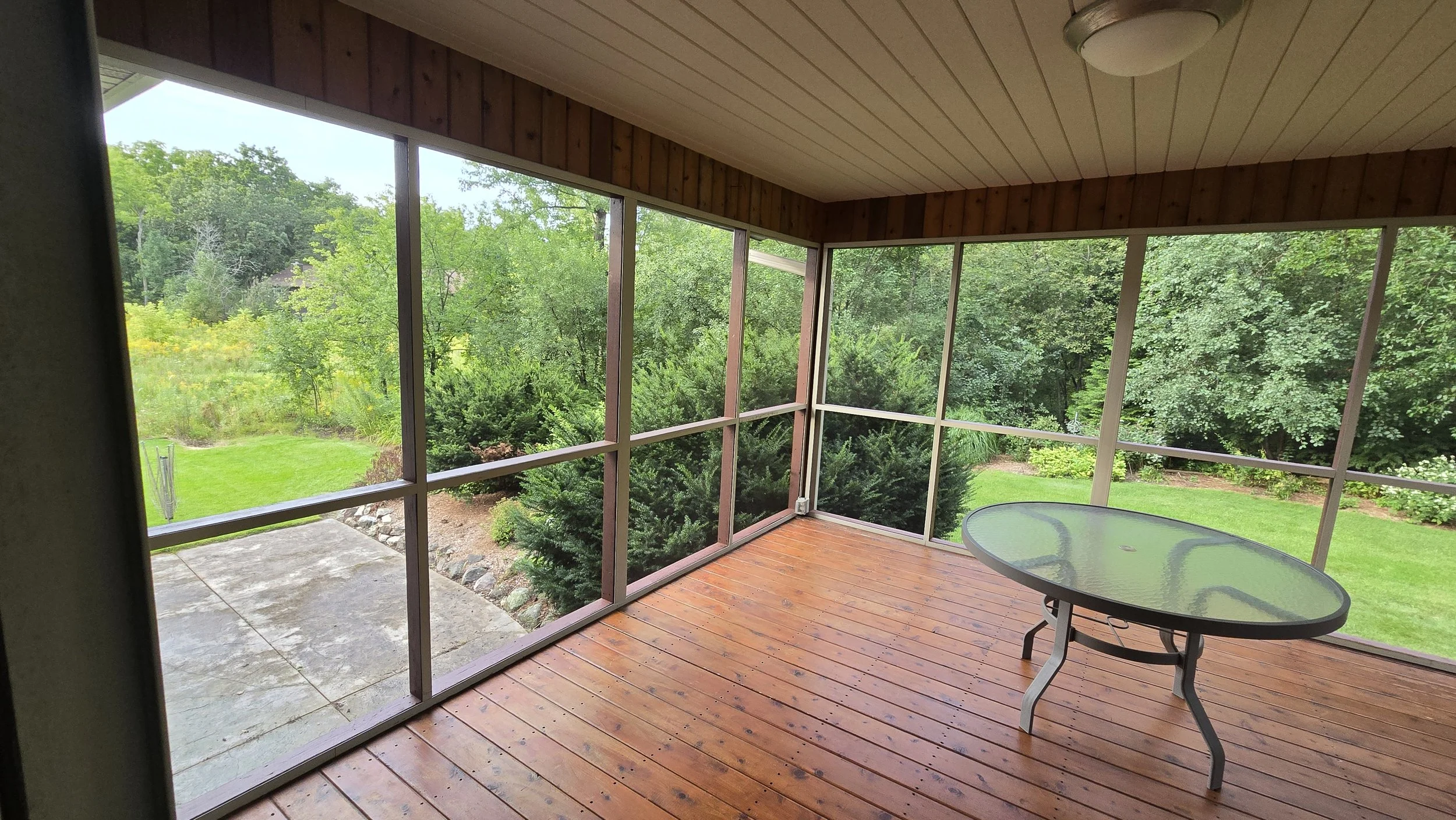
A newly re-screen porch using standard fiberglass screening
Fiberglass is desirable for its cost-effectiveness, ease of installation, and high visibility as well as low-glare. If you have a screened porch built in the last few years, chances are it uses some variation of fiberglass screening.
With fiberglass, there are a few options for how thick the material is. There is a simple tradeoff between visibility (thinner material) and durability (thicker material). The important thing to remember is that overall fiberglass offer good visibility and low glare, while also being less durable than metal options or Pet Screen (more on those later).
Standard thickness fiberglass:
the go-to option for most applications.
“Clear Vue” or “Crystal Clear”:
higher visibility at the cost of durability. Recommended for those who prioritize the view, and NOT recommended for anybody with pets or children using the porch.
Heavy-duty fiberglass:
Lower visibility, but higher durability. Recommended for standard applications but with a preference to minimize future repair needs.
1 more note on fiberglass: it almost always comes in “charcoal” color. This reduces glare and provides an attractive overall appearance.
Metal screens: Pros and Cons
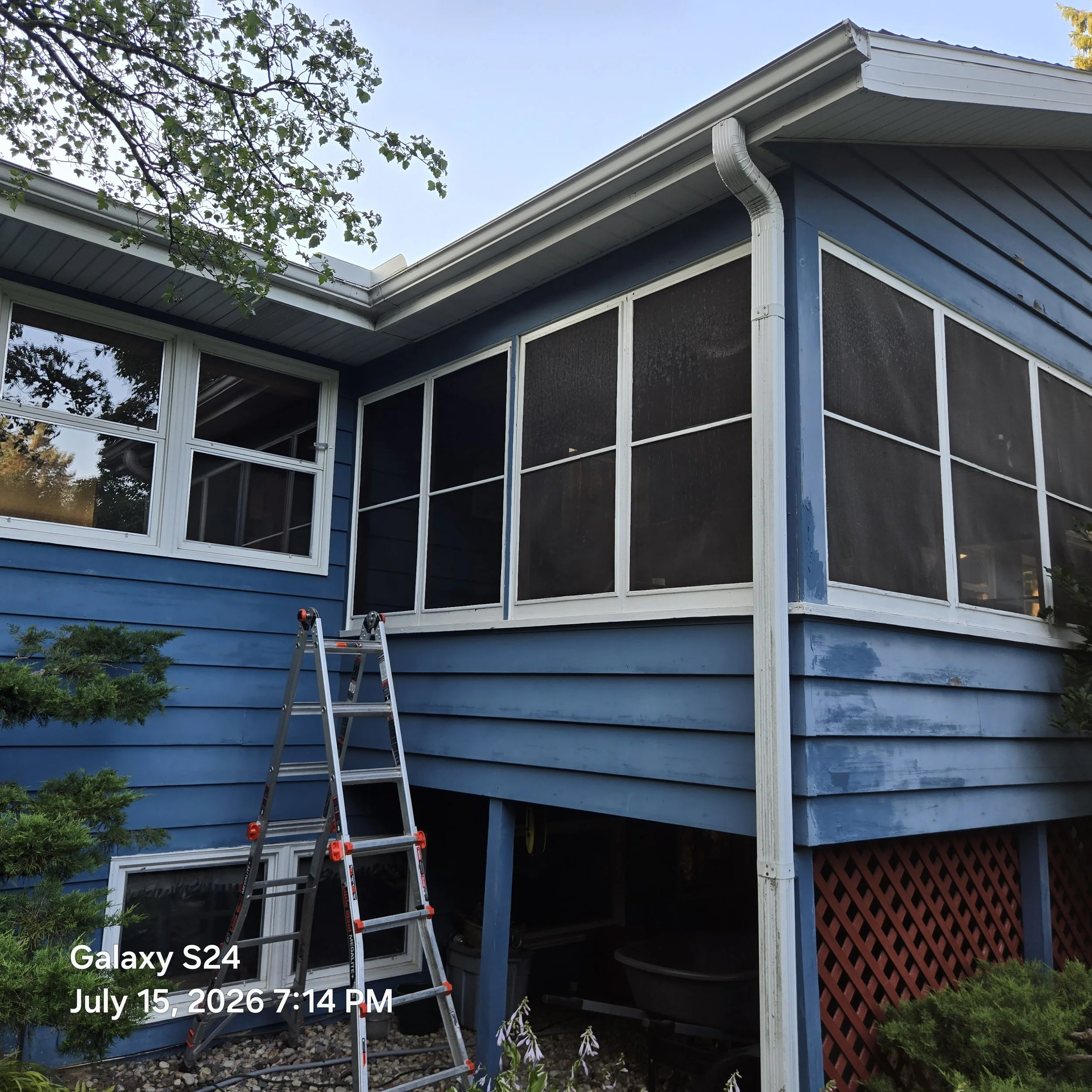
Replacing old aluminum screens with new charcoal aluminum screens (left 2 windows replaced).
Metal screens are higher-durability than any fiberglass options, with the slight cost of lower visibility, and considerably higher cost. Metal screening is much more resistant to tearing, BUT a heavy impact will dent metal screening. This won’t compromise its ability to deter insects, but will reduce its aesthetic appeal and impair views.
The most common metal screening material is aluminum. It doesn’t rust, but will oxidize over many years, becoming faded and brittle.
The gold-standard for metal screening is stainless steel. It won’t rust or oxidize, even over many years, and is far more dent-resistant than aluminum.
It is also important to know that metal screening is a bit more unwieldy to install compared to fiberglass. It doesn’t stretch as easily, but does have more structural rigidity, so it isn’t as “floppy” or loose if not installed correctly. However, mishandling it can dent it or crush the entire roll, leaving a very unattractive final product. It is also slightly more hazardous with it’s sharp wire edges - so wear gloves if installing!
Metal screen usually comes uncoated (silvery or chrome looking) or with a charcoal-colored coating. The latter is usually preferable for reduced glare and appearance, but scratches can show more easily as they remove a small amount of the coating.
Pet Screen: the premium choice for pet owners
While at first glance, pet screen appears to be similar to fiberglass screen, it is actually polyester coated in vinyl. The result is a product that behaves like extra-heavy-duty fiberglass, with an impressively high resistance to scratches and damage. Cats can often climb right up the screen without damaging! The drawbacks are of course the lower visibility compared to fiberglass, and the notably higher cost. Pet Screen is easy to install, as it it won’t deform like metal, but is also more forgiving than fiberglass in terms of tearing if stretched.
TLDR: Pros and Cons of Screen Material
Least durable ← Fiberglass (varies by thickness) < Aluminum < Pet Screen < Stainless Steel → Most durable
→Aluminum: tear resistant but will dent
→Pet Screen and Stainless Steel: tear and dent resistant
→Fiberglass: dent resistant but tears easily
Highest visibility ← Fiberglass (varies by thickness) < Aluminum < Stainless Steel < Pet Screen → Lowest visibility
Screen Installation Systems
The other major competent of screened-porch, after the type of screening, is how that screening is actually installed. In our experience, there are 3 methods, 2 of which are by far the most common.
Option 1: fastened to porch framing
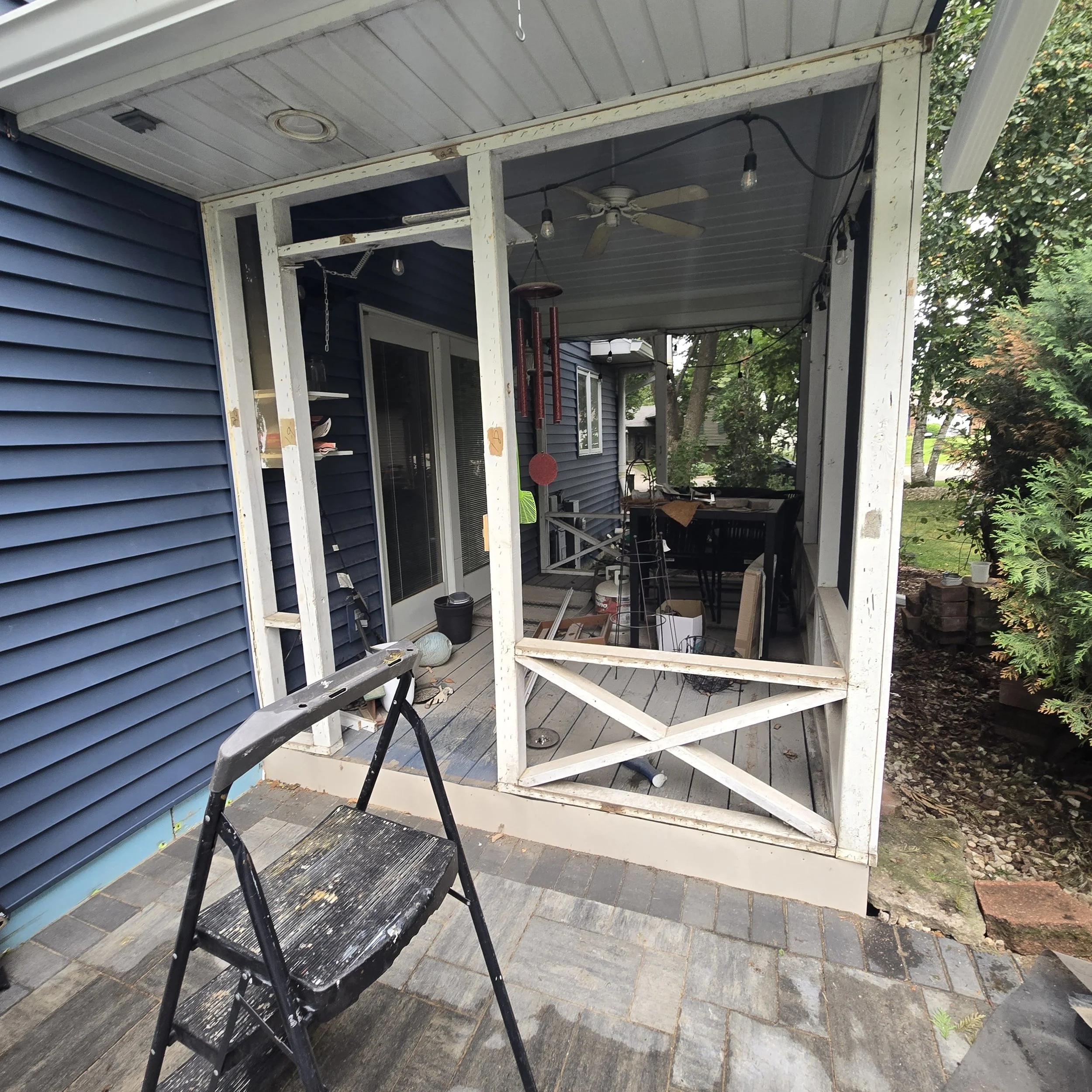
Example of a porch with the screen and exterior trim removed (screen fastened directly to porch framing)
Probably the most common option to install a screen is to simply staple it to the exterior of the porch framing, and then cover the edges with some kind of trim. For porches with screen windows, the trim is usually thin whereas for fully-screened porches, the entire frame is often covered with trim (LP Smart Side is a common choice). This option is the simplest, cheapest, and can be used for any kind of screening. However, it is often more difficult to replace screen panels as several pieces of trim need to be removed and the trim is often on the exterior of the porch- this is especially true for elevated porches or those obscured by trees!
Option 2: a spline and channel system
More difficult to install but easier to repair is a system of channels (secured to the porch framing) which hold screening with the use of vinyl spline. This is very similar to how most windows or screen doors work. The channels are then covered with vinyl snap-in trim.
“Scree Tight” is the most common brand who sells this kind of product:
https://www.screentight.com/
Another thing to note about using a spline/channel system is that while it can work with both fiberglass and metal screening, it is more difficult to use metal screening with these system; most often they support fiberglass screen installations.
The “newcomer”: Screeneze
Screeneze uses a “snap-track” system which requires neither spline nor fasteners, and is rated for much wider spans of screen than more conventional systems. The website says it was introduced in 2003, so perhaps it isn’t especially new, but it is something we at FTC Handyman have only recently encountered, and it is far less common than the other 2 methods.
https://www.screeneze.com/products/snaptrack
Pro-Tip: install your screens on the inside
Okay, this is a bit self-serving, I admit. Most screen porches have the screening installed to the outside of the frame (weather using a spline system or simple fastening). The appeal is that the trim is not visible from the inside, and you get a bit more space. That said, if you can accept it aesthetically, it is substantially easier to install and to repair the screening from the inside. Think about it: from the outside, you have to deal with trees, uneven ground, and heights! Most porches are elevated above ground, often on an upper level. Therefore, a ladder is required and needs to be relocated for each panel! This can be extremely time-consuming and potentially hazardous.
From the inside, many panels are accessible with a standard step ladder and the working space is nice a flat… and shaded!
This advice doesn’t help if you already have the porch - but if you are considering installing a new porch with screens, or installing a screen system to an existing porch, do your installer and any future repair contractors a favor and consider installing it inside the porch. We’ll thank you later!
Replacing Screen Panels and Re-Screening entire porches
Hopefully this helps anybody thinking about installing new screens systems, or considering options for how to best address any damaged or faded screens.
Floor-to-Ceiling Handyman has experience repairing and re-screening screen systems of all kinds.
You can check out the service spotlight here: https://ftc-handyman.com/rescreen
And here is a gallery of some of our past rescreening work: https://ftc-handyman.com/gallery/porch-rescreening
So if hail strike again or you just get tired of ripped or ugly screens, we can help!